AI for Small Business: 5 Quick Wins
AI Does Not Have to Be a Six-Figure Transformation
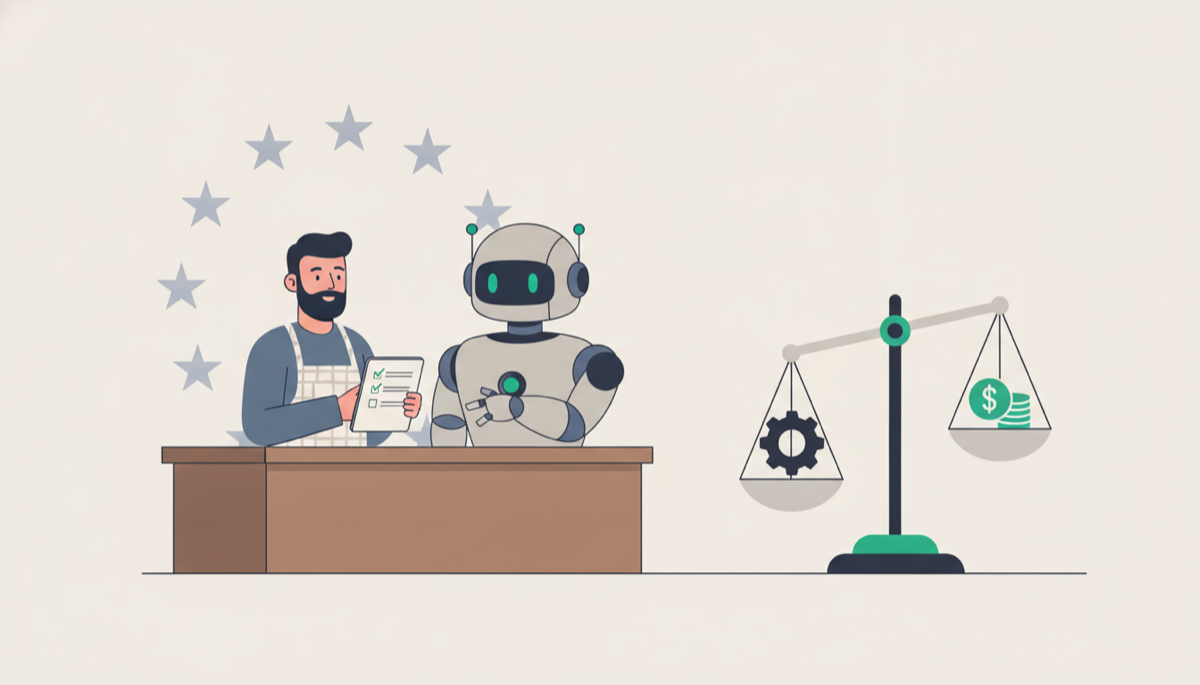
When business owners hear "AI implementation," they picture a twelve-month project, a team of data scientists, and an invoice that runs to six figures. That is one version of AI adoption — but it is not the only one.
The most successful AI implementations I see in small and medium businesses are focused, low-risk projects that solve one specific problem and show a return within weeks. They do not require replacing existing systems, hiring specialists, or buying enterprise software. For a step-by-step look at how these projects actually unfold, see How AI Automation Works in Practice.
Here are five AI projects that regularly deliver measurable ROI for businesses with 10–100 employees. Each costs under 5,000 EUR to build and shows results quickly.
Project 1: Customer Support Chatbot
Investment: 2,000–4,000 EUR Timeline: 3–4 weeks ROI: 30–50% reduction in first-response support volume
The problem: Your team spends a disproportionate amount of time answering the same questions. Order status. Return policy. Opening hours. Pricing. Product specifications. These questions are important to the customer but require no expertise to answer — just patience and access to information you already have.
The solution: An AI chatbot trained on your FAQ, product documentation, and policies. It handles common questions 24/7 and escalates to a human only when the question falls outside its knowledge.
How it works: You provide the knowledge base — FAQs, product specs, policies, common customer questions and answers. The AI system is configured to handle your specific types of enquiries. It integrates with your website or messaging platform.
What to expect: Businesses typically see 30–50% of inbound support volume handled automatically within the first month. That time goes back to your team for higher-value work.
When it is worth it: You are answering the same questions multiple times per day. Your team spends more than 5 hours per week on repetitive first-level support.
Project 2: Document Processing Automation
Investment: 2,500–5,000 EUR Timeline: 3–5 weeks ROI: 60–80% reduction in manual data entry time
The problem: Your business receives documents — invoices, delivery notes, application forms, contracts — and someone manually reads them and enters the data into your systems. This is slow, error-prone, and mind-numbing work.
The solution: An AI document processing pipeline that reads incoming documents, extracts the relevant fields, validates them, and pushes the data into your system automatically.
How it works: You define the document types you process and the fields you need (vendor name, invoice number, line items, totals, dates). The AI pipeline is trained on examples of your actual documents and integrated with your existing accounting or ERP system.
What to expect: For standard document types (invoices, delivery notes), accuracy rates of 90–95% are typical. The remaining 5–10% are flagged for human review, but the total human effort drops dramatically. A task that took 2 hours per day typically drops to 20 minutes.
When it is worth it: You process more than 50 documents per week manually. Data entry errors cause downstream problems or require correction time.
Project 3: Email Triage and Draft Generation
Investment: 1,500–3,000 EUR Timeline: 2–3 weeks ROI: 40–60% reduction in email handling time
The problem: Email is a significant time sink for small businesses. Sorting, reading, deciding who should handle what, writing responses — it adds up. For businesses with a shared inbox or sales teams handling inbound enquiries, the inefficiency multiplies.
The solution: An AI email assistant that reads incoming emails, classifies them (sales enquiry, support request, complaint, invoice, newsletter), extracts key information, and either auto-drafts a response or routes the email to the right person with a summary.
How it works: The system connects to your email (Gmail, Outlook). You define the categories relevant to your business and the routing rules. For each incoming email, the AI produces a summary, assigns a category, suggests a priority, and optionally drafts a reply for the recipient to review and send.
What to expect: Email processing time for most businesses drops by 40–60%. The biggest win is for shared inboxes where multiple people were all reading the same emails to decide who should respond.
When it is worth it: Your team collectively spends more than 3 hours per day on email. You have a shared inbox that causes confusion about ownership. You frequently write similar replies to similar questions.
Project 4: Automated Business Reporting
Investment: 1,500–3,500 EUR Timeline: 2–4 weeks ROI: 5–10 hours per week recovered from manual reporting
The problem: Someone on your team — often you — spends hours each week pulling data from different sources, dropping it into a spreadsheet, calculating figures, and writing a summary. This report is important, but the process of creating it is entirely mechanical.
The solution: An automated pipeline that pulls data from your sources (POS system, e-commerce platform, CRM, accounting software, spreadsheets), processes it, and generates a formatted report with key metrics, trends, and highlights — delivered to the right people on a schedule.
How it works: You define what data sources you have, what metrics matter, and what the report should look like. The pipeline is built to connect your data sources, run the calculations, and format the output. Reports are delivered by email or to a shared dashboard.
What to expect: Manual reporting time drops to near zero for the automated report. Teams typically reclaim 5–10 hours per week. More importantly, reports become more consistent — they are no longer delayed when the person who does them is on holiday.
When it is worth it: You produce the same or similar reports weekly or monthly. The data already exists in digital form but is spread across multiple tools. Report creation takes more than 2 hours per week.
Project 5: Product Image Tagging and Categorisation
Investment: 1,500–3,000 EUR Timeline: 2–3 weeks ROI: 80–90% reduction in manual tagging time; improved search and filtering for customers
The problem: If you sell physical products online, your product catalogue requires attributes, tags, and categories. Applying these manually to thousands of product images takes days and produces inconsistent results. Poor tagging means customers cannot find what they are looking for.
The solution: An AI image analysis pipeline that processes product photos and automatically generates tags, categories, attributes (colour, style, material, shape), and descriptions — with a human review step for edge cases.
How it works: You define your tagging taxonomy — what categories, what attributes, what tags matter for your catalogue. The AI is configured to analyse product images and produce structured attribute data. You review and correct a sample; the system learns from corrections.
What to expect: Tagging time drops by 80–90% for standard product types. Consistency improves dramatically, which typically leads to improved search results and better filtering on your site.
When it is worth it: You have more than 500 products to tag or regularly add new products. Your team spends more than 5 hours per week on manual tagging. Poor search results are causing you to lose sales.
How to Choose Your First Project
Not all five projects will be relevant to your business. Use this checklist to prioritise:
- Where does your team spend the most time on repetitive tasks? That is your highest-ROI target.
- What causes the most friction in your customer interactions? A chatbot or faster response time there pays off quickly.
- Where do errors cause the most downstream pain? Document processing errors that cascade into accounting issues are expensive to fix.
- What reports does your leadership spend time creating manually? Automated reporting has a very predictable payoff.
Start with one project. Build it, measure the result, and use the time savings to fund the next one. AI transformation does not require a big bang — it requires a series of well-chosen, well-executed small wins.
If you are not sure which project to start with, a short AI readiness consultation will give you a prioritised list specific to your business.
Let’s talk about your project
Free 30-minute consultation. We’ll figure out if and how I can help.